

Why Choose Organic? Healthier Soil, Happier Wildlife 🌱
Why Choose Organic?
When you think of Organic what do you see? Pricier products? Vegetables that are better for you? Small farms? Well this week, we will look at the benefits of choosing to buy organic. Some may surprise you...
Protection of Soil for the Future
Approximately ⅓ of the Earth’s soils are degraded (FAO 2017), and they are continuing to degrade. This means that soils are decreasing in quality and amount (through erosion) which poses a threat to farmers’ ability to produce food in the future (Soil Association 3).
This degradation has come about through intensive farming methods, leading to the compaction and run off of soil. In intensive farming, agrochemicals are seen as the main source of soil fertility and control of pests and diseases (Soil Association 3), which is making the problem worse.
How Organic Farming Benefits Soil Health
Organic Farming Method |
How it Benefits Soil Health |
|
Encouraging and increasing the amount of soil organisms e.g. worms |
-Soil organisms both build up the soil and release nutrients into it, reducing the need for artificial nutrient introduction by agro-chemicals |
|
Crop rotation |
-Continuous planting of arable crops can strip the soil of its nutrients. Giving the soil a break from intensive arable planting can help maintain the nutrients and give time for the soils to recover |
|
Continuous plant cover |
-Healthy soil is covered soil. Roots help to keep the soil together and allow oxygen to reach the soil. This then helps plant-fungal interactions and brings huge gains in terms of biodiversity, carbon storage, flood and drought control, and water quality. |
|
Reduction of soil damage from livestock and machinery |
-Reducing compaction and run-off (erosion). Helping to maintain good crop yield and healthy root formation, increasing the amount of oxygen that can reach the soil. |
(Info from Soil Association 3)

Animal Welfare
Soil Association and organic farming regulations mean that organic farming requires the highest animal welfare standards of any farming system worldwide (Soil Association 1). These regulations include that the animals are free-range, encouraged to display natural behaviours like foraging, grazing and roaming their habitats, spacious living conditions and fresh air. No small cages and cramped dark sheds here!

Climate Change
In simple terms, organic farming = less greenhouse gas emissions.
But how?
Man-made chemical fertilisers and pesticides are made by burning fossil fuels, which leads to greenhouse gas emissions.
Instead, organic farmers build and maintain fertile soils in a natural way, and these healthy soils store more carbon. A staggering 2,500 billion tonnes of carbon is stored in the world’s soils, and organic soil is 25% more effective in storing carbon in the long run, preventing it from being released into the atmosphere. (Soil Association 1)

Trustworthy Ingredients
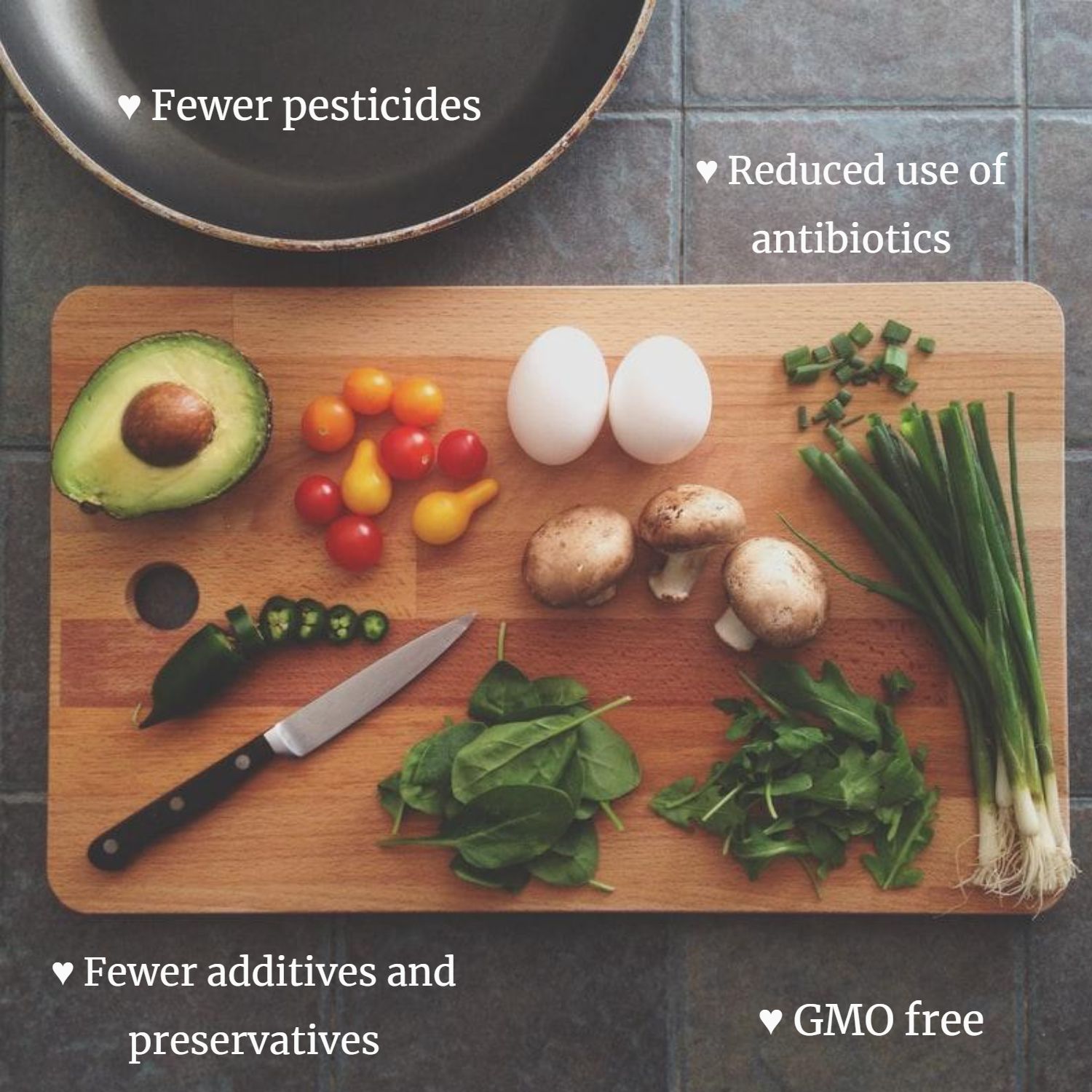
When you choose organic, you’re choosing products made without artificial additives, chemical pesticides, or genetically modified ingredients. Organic certifications ensure strict standards for purity and sustainability.
At Eco Natural Products, we are proud to offer a range of trusted organic brands, including

Biona – delivering a wide selection of wholesome, certified organic foods made with sustainably sourced ingredients.
Clearspring – offering authentic Japanese and organic fine foods crafted with traditional methods and sustainably sourced ingredients.
Natur Boutique – diverse selection of certified organic herbal teas, crafted with pure ingredients and traditional methods to promote wellness and sustainability.
Dr Organic – delivering certified organic skincare, haircare, and bodycare products crafted with ethically sourced, plant-based ingredients and sustainable practices.
Nat Origin – offering high-tolerance, hypoallergenic cosmetics and skincare crafted with over 97% natural ingredients, ideal for sensitive skin and eyes.
Organic Shop – a curated range of certified organic essentials.
Mr. Organic – offering delicious organic sauces, condiments, and pantry staples.
Golden Greens Organic – supplying superfoods and supplements sourced with the highest organic standards.
These brands uphold the commitment to transparency, quality, and respect for both people and the planet.
Wildlife
Organic farming can benefit wildlife in many ways. From encouraging the diversity of crop and plant species, to the reduction of man-made pesticides.
The expansion and intensification of agricultural and farmland has been shown to be a threat to biodiversity worldwide (Green et al 2005) and this has happened in many ways, including a reduction in crop diversity and the removal of hedgerows to create more space for planting etc. This all leads to the homogeneity of the landscape (Stoate et al 2005), and this is the opposite of what is good for wildlife.
A recent study showed that butterfly species was 50% higher on organic farms compared to intensive farmland (Harmand et al 2015)
Agri-environmental schemes exist in the UK to compensate farmers for the added cost of carrying out wildlife-friendly management on their farms (RSPB 2020). These management techniques include leaving longer vegetation strips at the edge of fields, having strips of wild flowers to benefit insects like bees and butterflies, and creating banks to act as cover for small mammals etc.

Source
FAO 2017: http://www.fao.org/3/a-i7480e.pdf
Green et al 2005: Green, R.E., Cornell, S.J., Scharlemann, J.P.W. & Balmford, A. (2005)
Farming and the fate of wild nature. Science, 307, 550–555
Hardman et al 2015: Hardman, C.J., Harrison, D.P.G., Shaw, P.J., Nevard, T.D., Hughes, B., Potts, S.G., and Norris, K. (2015). Supporting Local Diversity of Habitats and Species on Farmland: A Comparison of Three Wildlife-Friendly Schemes. Journal of Applied Ecology [online].
RSPB 2020: https://www.rspb.org.uk/our-work/our-positions-and-casework/our-positions/agriculture-and-land-use/agri-environment-schemes/
Stoate et al 2005: Stoate, C., Boatman, N.D., Borralho, R.J., Carvalho, C.R., de Snoo, G.R.
& Eden, P. (2001) Ecological impacts of arable intensification in Eur-
ope. Journal of Environmental Management, 63, 337–365.
Soil Association 1: https://www.soilassociation.org/organic-living/why-organic/
Soil Association 2: https://www.soilassociation.org/iddri-report-ten-years-for-agroecology-in-europe/
Soil Association 3: https://www.soilassociation.org/media/4672/7-ways-to-save-our-soils-2016.pdf


