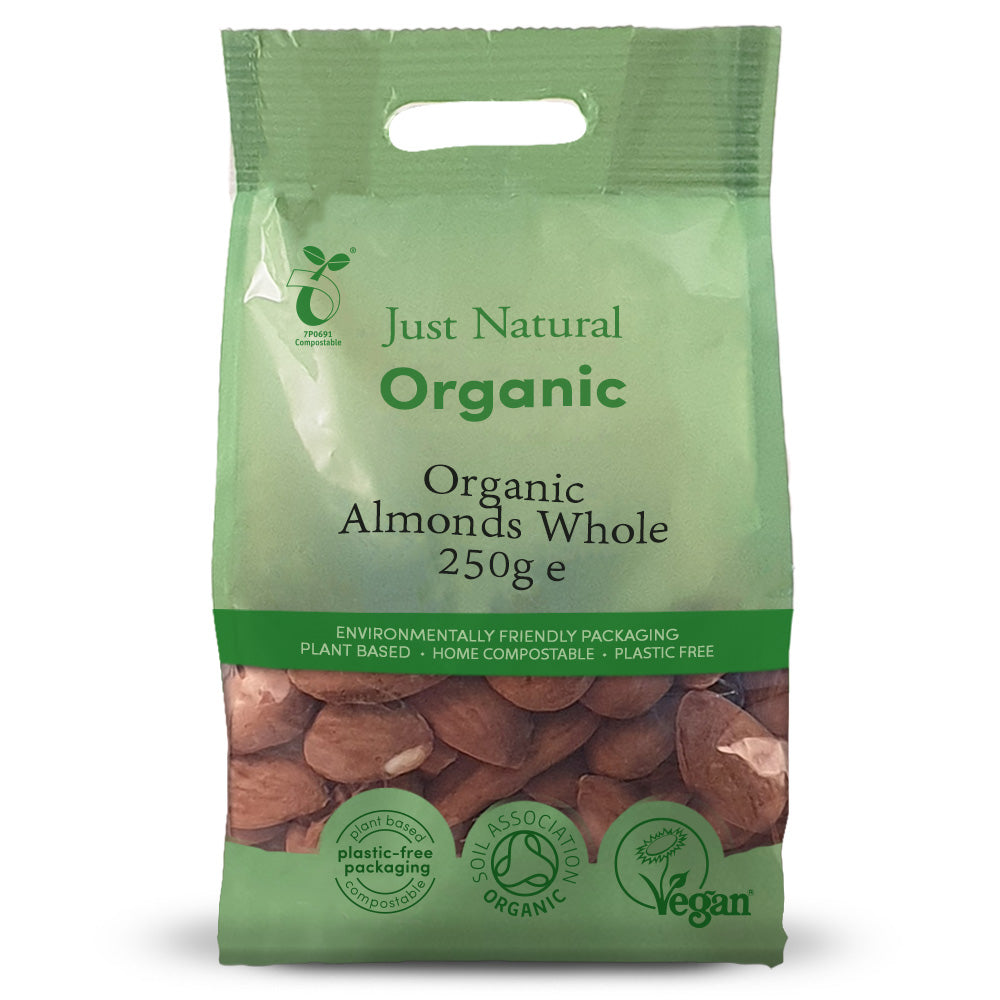
Organic Almonds Whole 125g/250g/500g
Organic Almonds Whole 125g/250g/500g


Couldn't load pickup availability
Whole raw almonds are one of the most nutrient-dense nuts available — exceptionally rich in Vitamin E, magnesium, calcium, and healthy monounsaturated fats (predominantly oleic acid, the same fatty acid found in olive oil). These certified organic whole almonds from Just Natural Organic are raw and unskinned, retaining their natural brown outer skin which contains concentrated flavonoids and fibre.
A 30g serving (a small handful) provides around 165 kcal, 6g of protein, 3.5g of fibre, and 48% of the adult NRV for Vitamin E. Almonds are also one of the most satiating snacks — research consistently shows that their fibre, protein, and fat content together reduce post-snack hunger more effectively than most other nuts.
Certified organic by the Soil Association. Plastic-free, home-compostable packaging. Available in 125g, 250g and 500g.
Eat straight from the bag as a snack. Soak overnight and blend into homemade almond milk. Chop and scatter over porridge, salads, or roasted vegetables. Toast in a dry pan for 5 minutes to intensify their flavour. Press into energy balls or granola bars. Use in marzipan, frangipane, or baked goods.
Recipe idea — Homemade Almond Milk: Soak 150g organic whole almonds in cold water overnight. Drain and rinse, then blend with 750ml fresh water for 2 minutes until very smooth. Strain through a nut milk bag or fine cloth, squeezing out all the liquid. Season with a pinch of salt and a teaspoon of maple syrup if desired. Keeps refrigerated for 3–4 days. The leftover almond pulp can be dried and used as almond meal in baking.
| Nutritional Values per 100g | |
|---|---|
| Energy | 2423 kJ / 579 kcal |
| Fat | 50g |
| Of Which Saturates | 3.8g |
| Carbohydrates | 22g |
| Of Which Sugars | 4.2g |
| Fibre | 12.5g |
| Protein | 21g |
| Salt | 0.01g |
Key nutrients: Outstanding source of Vitamin E (172% NRV per 100g), magnesium (65% NRV), calcium, phosphorus, riboflavin (B2), and manganese. High in monounsaturated fatty acids (oleic acid) and dietary fibre (12.5g/100g).
Ingredients: Organic Whole Almonds.
FAQs
Should I soak almonds before eating?
Soaking almonds overnight in cold water softens their texture and may improve digestibility by reducing phytic acid (an antinutrient that can inhibit mineral absorption). Soaked almonds have a milder flavour and creamier texture. For eating raw as a snack, soaking is optional — unsoaked almonds are perfectly nutritious. For making almond milk or almond flour, soaking is recommended.
What is the difference between whole, blanched, and ground almonds?
Whole almonds retain their natural brown skin, which contains fibre and flavonoids. Blanched almonds have had their skin removed by brief boiling, leaving the smooth white kernel — milder in flavour and more commonly used in baking and confectionery. Ground almonds are blanched almonds that have been milled into a coarse flour — ideal for macarons, frangipane, and gluten-free baking.
Are almonds good for heart health?
Almonds are one of the most studied nuts for cardiovascular health. Their high monounsaturated fat content, alongside Vitamin E, magnesium, and fibre, is associated in research with reduced LDL cholesterol and improved endothelial function when consumed as part of a balanced diet.
Are these suitable for people with tree nut allergies?
No — almonds are a tree nut and a major allergen. They should be strictly avoided by those with tree nut allergies.
How should I store organic almonds?
Store in an airtight container in a cool, dry, dark place. Almonds can be refrigerated or frozen to extend shelf life, particularly in warm weather. Their high fat content means they can eventually turn rancid if stored in warm, humid, or light-exposed conditions.