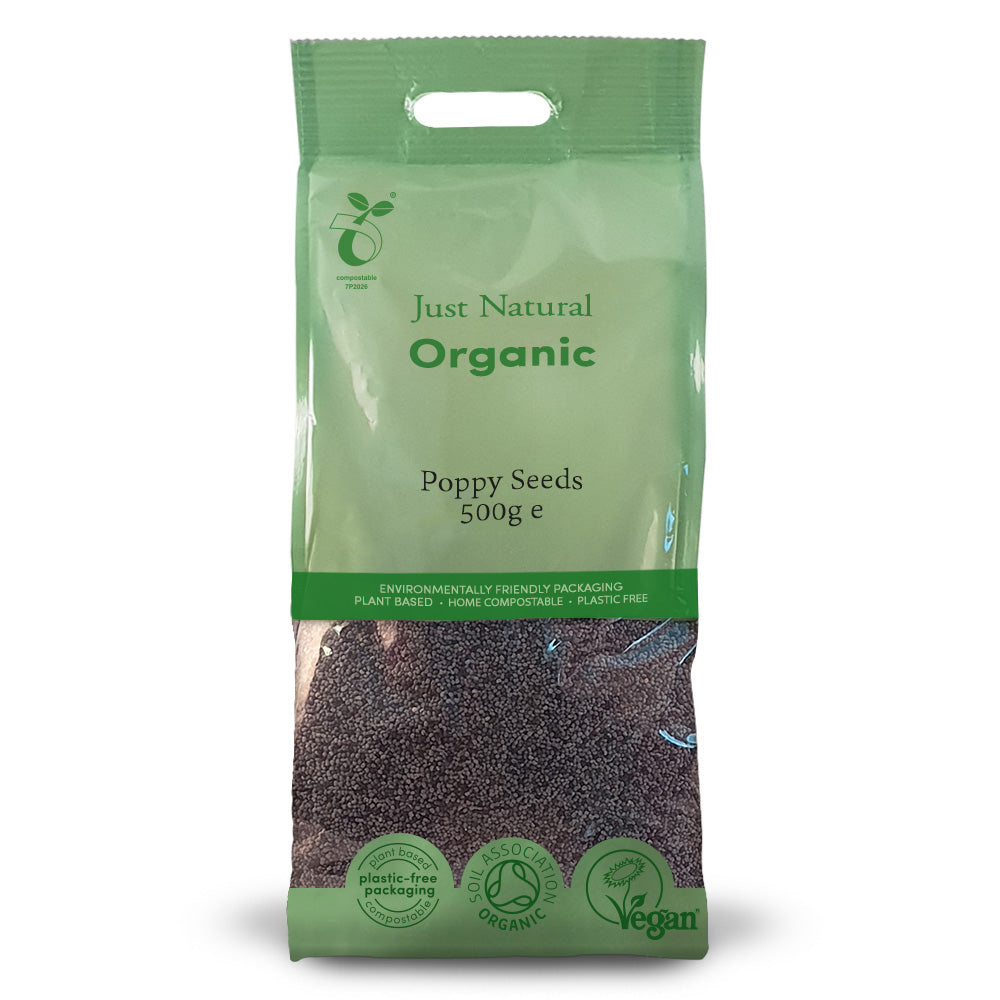
Organic Poppy Seeds 500g
Organic Poppy Seeds 500g


Couldn't load pickup availability
Poppy seeds have been cultivated as a culinary ingredient for over 3,000 years — prized in European, Middle Eastern, and South Asian baking for their delicate, subtly nutty crunch. These certified organic poppy seeds from Just Natural Organic are the blue-grey variety most commonly used in European cooking, with a mild flavour that works equally well in sweet and savoury applications.
Nutritionally, they are an excellent source of calcium, manganese, magnesium, and phosphorus, and contain notable amounts of zinc, iron, and dietary fibre. Their fat content is predominantly polyunsaturated, including omega-6 linoleic acid.
Certified organic by the Soil Association. Plastic-free, home-compostable packaging. Available in 500g.
Scatter over bread rolls, bagels, or crackers before baking. Mix into pastry dough for a traditional poppy seed shortcrust. Use in German mohn filling for strudel or rolls. Toast lightly and scatter over salad dressings or pasta. Add to lemon cakes, muffins, or pancakes. Use as a topping for flat breads.
Recipe idea — Lemon & Poppy Seed Drizzle Cake: Beat 175g butter with 175g caster sugar until pale. Beat in 3 eggs, then fold in 175g self-raising flour, 2 tbsp poppy seeds, zest of 2 lemons, and 3 tbsp milk. Bake in a loaf tin at 180°C for 45–50 minutes. While warm, poke holes and drizzle over the juice of 1 lemon mixed with 2 tbsp icing sugar. The poppy seeds add a pleasant crunch and a subtle nutty depth that complements the lemon perfectly.
| Nutritional Values per 100g | |
|---|---|
| Energy | 2387 kJ / 571 kcal |
| Fat | 46g |
| Of Which Saturates | 4.5g |
| Carbohydrates | 28g |
| Of Which Sugars | 3g |
| Fibre | 20g |
| Protein | 18g |
| Salt | 0.03g |
Key nutrients: Excellent source of calcium (1438mg/100g — 180% NRV), manganese, magnesium, phosphorus, zinc, and iron. High in dietary fibre (20g/100g) and plant protein (18g/100g). Rich in polyunsaturated fatty acids.
Ingredients: Organic Poppy Seeds.
FAQs
Are poppy seeds safe to eat?
Yes — food-grade poppy seeds sold for culinary use are safe and contain only negligible trace amounts of opiate alkaloids, far below any pharmacological effect. They are widely used in baking across Europe and are completely legal to buy and consume in the UK.
Why are poppy seeds so high in calcium?
Poppy seeds contain exceptionally high levels of calcium — around 1438mg per 100g, making them one of the most concentrated plant-based calcium sources. This calcium is concentrated in the seed coat. A tablespoon (10g) provides around 144mg of calcium — roughly the same as a small glass of milk.
Do poppy seeds need to be toasted before use?
Toasting in a dry pan for 2–3 minutes enhances their nutty flavour and makes them more aromatic, which is particularly worthwhile if using them in dressings or as a garnish. For baking (bread, cakes, pastry), they can be used raw directly from the bag.
Are they gluten-free?
Yes — poppy seeds are naturally gluten-free. Packed in a facility handling gluten-containing grains, so check the label if you have coeliac disease.
How long do poppy seeds keep?
Stored in a cool, dry, airtight container away from direct sunlight, poppy seeds keep well for 12–18 months. Their high fat content means they can eventually turn rancid if stored in warm or humid conditions — refrigeration extends shelf life after opening.